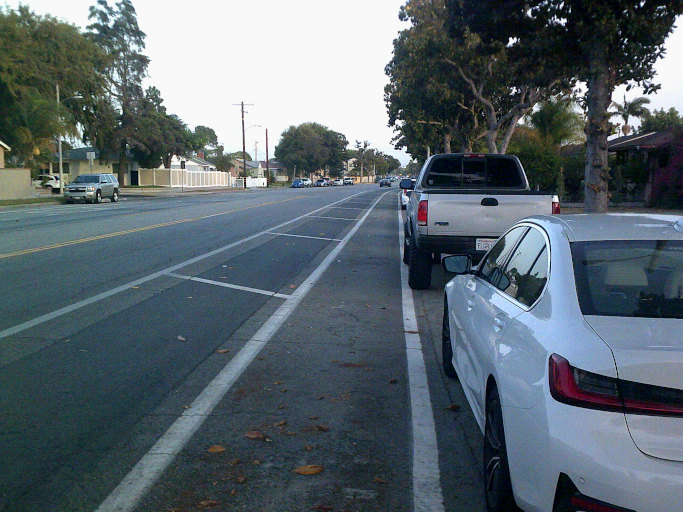
so you have to ride on the left line.
Need for a bike-friendly society
I was just thinking I should put up a page on my site about how our society is not very bike-friendly, and how the designers of roads and buildings show they don't understand the problems. I don't think they even try to understand.
I hope to keep adding more points here long after I post this. You can also email me with more, using the address at the bottom of the page. It's good to give examples in the pattern of disregard in construction and maintenance.
Here's an example. This is right near our house, and these vehicles are parked legally (ie, not too far from the curb), and yet the bike lane was painted to be the door zone, such that if you ride in it, you will eventually hit a door that someone opens just as you're getting there:
so you have to ride on the left line.
It's bad enough that people think bikes don't belong on the road because they don't pay vehicle license fees and gas taxes. Local streets and roads are paid for by property taxes and sales taxes though, not vehicle license fees and gas taxes. Most cyclists are also drivers anyway, but they're not damaging the roads when they ride bike like they would with their heavy vehicles.
Adding to that, some people think, "Roads are for cars!", forgetting that there were roads thousands of years before there were cars. It was the League of American Bicyclists ("Wheelmen" back then) that originally pushed for paved roads over a hundred years ago. So why is it that now that the drivers have something they like, namely paved roads, they want those who got them for them, off the road?!
Or how about this excuse: "Cyclists break the rules." Please don't be one of them. I and my family do not run red lights and stop signs, nor ride two abreast where it would inconvenience the drivers (even if it's legal), take the lane when it's not necessary, etc.. Those riders make drivers hate the rest of us too.
Traffic-light sensors' sensitivity is often not turned up high enough to sense bikes and turn the light green for you. BTW, these do not sense magnetic disturbances (so putting a magnet on your shoe won't help), nor do they sense weight. The traffic-light controller puts an alternating-current signal, generally in the frequency range of 20 to 200kHz, through the loop of wire that's tucked into a slot in the pavement, setting up an electromagnetic field. If you put your metal bicycle wheel over it, the field partially collapses on it, reducing the inductance of the loop, and the controller should know you're there waiting. Put your wheel on the cut of the loop, not inside the loop, nor across the cut, but right on it and parallel to it. See this page.
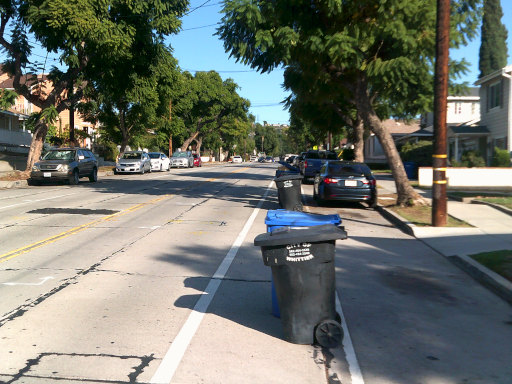
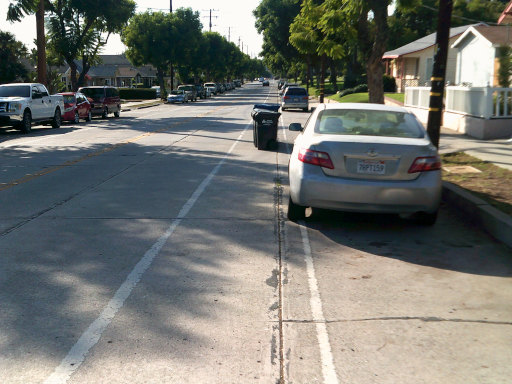
Then we have this kind of thing on trash day, where people put their containers in the lane:
We live near a 37-mile-long class-1 paved bike trail that's basically like an autobahn for bicycles, and you can go many miles at a time without slowing or stopping for anything; but I told a man in the county office that's responsible for it that I think whoever designed the trail went down a list of all the things not to do, for safety's sake, and made sure they had at least two of each. And the thing about it is that it wouldn't have cost them any more to do it right if they had done so in the beginning, but they've had to spend hundreds of thousands of dollars fixing things after they caused severe accidents.
About seven miles west, there's the Los Angeles River bike trail, and there has been an eight-mile gap through the downtown area which they're planning on remedying. In Dec 2025 / Jan 2026, they were soliciting input from the public; so I wrote the following:
I have, for years, wished the trail went through on this part of the L.A. river. I'm very glad that it's finally being seriously worked on! :)I and my family have put over 100,000 miles on the San Gabriel River trail (SGRT), and some on other trails like the lower L.A. river trail and the Santa Ana River trail plus ones in other counties, and I can tell you from plenty of experience what the dangers and problems are; so I send you this material in hopes that the same mistakes in trail design won't be repeated in the new section of the L.A. river trail.
Garth Wilson
- tunnels that have a blind entrance / exit. The Whittier Blvd tunnel on the SGRT is blind at one end, and the tunnel is too narrow anyway. We've seen accidents there, caused by this.
- onramps where people come downhill onto the trail but you can't see them because of a nice wrought-iron fence blocking the view (three times, I've nearly been hit this way).
- gates to the river that open toward, instead of away from, the trail, such that someone not paying attention may run into one that's left open
- motor vehicles on the trail. Minibikes are the worst, with professional bike racers' speed but lacking the riding skill which should accompany it, and they usually don't have even a lawnmower-grade muffler, and they're running much too rich and without smog equipment, so you have to hold your breath and hold your ears as they go by. I understand one hit and killed a woman who was riding bike near El Dorado Park in Long Beach about 18 months ago. Class-3 E-bikes are also illegal on these class-1 trails; but I don't see any enforcement. Same with full-on motorcycles I've seen going 60mph+ on the trail. There have also been homeless people's cars out there. I want police to give heavy fines and also impound equipment for such violations. It won't take many of these before word gets around and people stop doing this.
- underpasses that have very poor surface, and are curved as you go down under a street and up the other side, where the curving makes it hard to see oncoming traffic, and you're also trying to avoid the worst of the bumps and holes in the pavement in the underpasses, where it may be dark compared to being out in the bright sun you just came out of
- homeless people's shopping carts in the underpasses, where visibility is poor, and the trail is narrow in the underpass, and their carts, tents, or other obstacles are an especially huge problem if another fast cyclist is coming from the other direction and now suddenly there's almost no time to negotiate who will be first to take the narrow path remaining
- This one is not particularly a risk for accidents, but homeless people sometimes leave a stream of urine running across the trail, which is corrosive to our bicycles' drive trains, and there's no way to avoid riding through it. It would be good to crown the trail, ie, make it slightly humped, like any street, to make water run off to the sides.
- In the drawing we keep seeing of the bike riders and pedestrians on the envisioned trail (which is in your email quoted below), I can tell you that with those kids in particular, they'll get to horsin' around and one kid will push the other one directly into the path of the rider shown coming up from behind, and it will all happen too fast to avoid an accident. There needs to be some sort of strong encouragement for pedestrians to stay to the side, out of the way of cyclists.
- Drainage in some of the underpasses on the SGRT is very inadequate, and water and mud can get quite deep, and stay that way for many days after the rains have stopped.
- There are signs lumping the trail in with playgrounds as merely "recreational" facilities. Some of us rely on the trail to get to work and to school, and it's not right to close the gates to the trail any more than it's ok to close Whittier Blvd just because people use it to go to the movies. There have been times that I, or friends, have come home and not been able to easily get off at our usual exit, because the gate was locked while we were out; so we had to find a hole in the fence or try to climb over the gate and get our bike over, to get home. I sometimes pull a trailer with all my tools in it. There's no way I'd be able to get the trailer over the gate. You might say it's necessary to keep people from drowning when the river water gets high and fast; but then I see portions where there's no fence between the trail and the water, and access gates to those portions were not locked.
here's the response I got:
Hello, Garth,Thank you for sharing your feedback about the LA River Path Project. Your feedback has been noted and shared with the team. Please continue to be engaged as we move through the Draft Environmental Impact Report (DEIR) Public Comment Period.
Sincerely,
The LA River Path Project Team
Then there are things that are beyond stupid, like these:
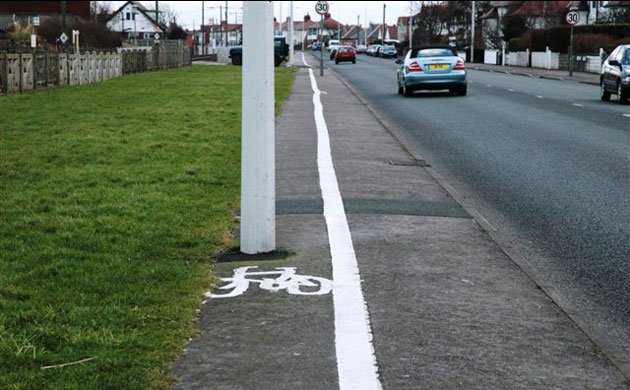
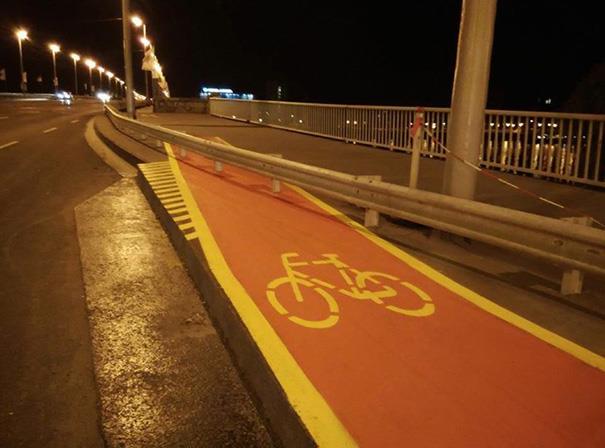
or just inconsiderate, like these:
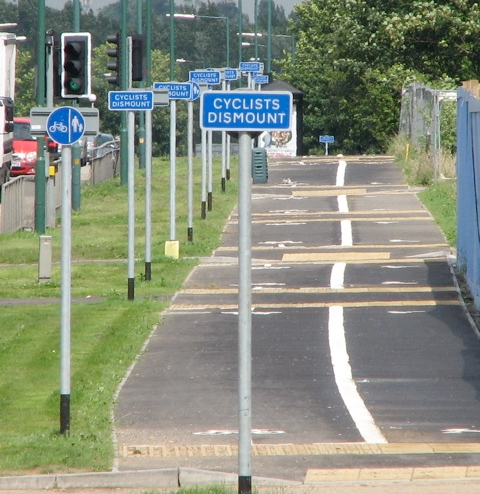
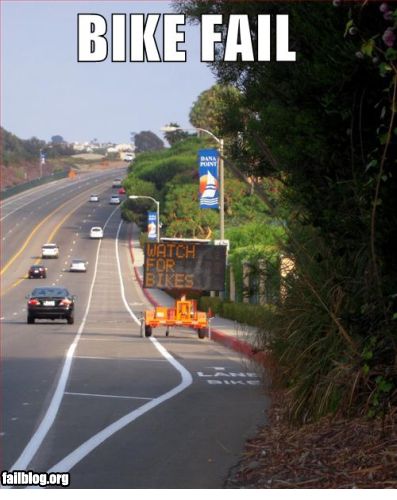
I came across this six-minute video and this 11½-minute one about why cyclists sometimes refuse to use bike lanes. They're in England, but many of the same things apply in the US. (And I'm sure there are many more such videos.) Bike lanes are often slower, more dangerous, and/or poorly maintained. The law does not obligate cyclists to use bike lanes.
In this picture (from a YouTube video), the bike lane is separated from car lanes by a curb and the parked cars. Some may think that's safer; but consider: someone may suddenly step onto the bike lane without looking, to get to or from one of the parked cars, and it will happen too fast to stop for them. You'll hit them.
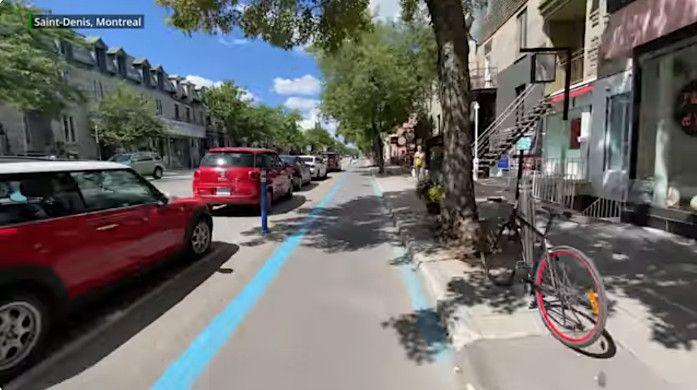
It's definitely not suitable for fast cyclists. A non-cyclist friend asked me, "What's the fastest you've gone on the bike trail?", probably thinking I'd say 15 or 18mph, as he exected to make a point about bikes being slow and should be kept out of traffic. I said that when I've had a good tail wind, I've gone 35mph for five miles at a time, but without that, it's more normal to go 23.
When I rode more for commuting and people would comment that it takes too long by bike, I used to say, "If you can get somewhere in town in 15 minutes, chances are, I can get there in under 18 on my bike." (That's certainly faster than going on the bus!)
In the following picture (also from a YouTube video), you can see the planners do not understand that fit cyclists, the ones most likely to commute significant distances, will find this unsuitable for their normals speeds:
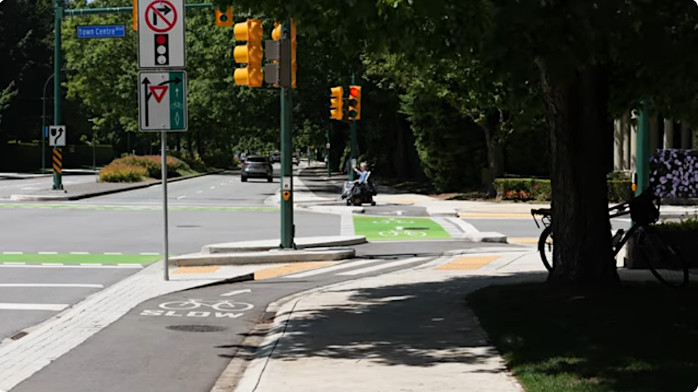
Further, since the cyclist is slightly separated from car traffic, a driver planning to turn right there is less likely to pay attention and do what the sign says which is to yield to bikes going straight. (See also that there's a man in a wheelchair pushing the "Walk" button, and he's in the way.) In California, sections 21202 and 21208 of the vehicle code give the six exceptions to the rule about riding as far to the right as practicable. One of them is to avoid the right-turn lane if you're not going to turn right, precisely to avoid that right-hook accident. I can see in the mirror when a driver behind me is planning to turn there, and I motion for them not to pass yet, then that I'm moving left, then wave them by on my right. They don't know how I can see them, but there's clear evidence that they appreciate that I'm looking out for everyone's safety and convenience.
In discussion about bike paths, some resent racing bikes, or anything they think looks like a racing bike, or anyone who wants to go fast, and they say, as if to "put us in our place," "This is about commuting! It's not a race!" I say that well, yes, it is a race—not against other riders, but against schedules and other pressures of life. Everyone has 24 hours in a day, for sleep, work, eating, personal care, down time, etc., and yes, transportation, and there may not be enough time to do the transportation by bike if you don't let fast riders go their normal speeds. Effective promotion of cycling requires allowing the things that will convince the businessman or other worker that it will finally be practical to leave his car at home and ride to work. When I rode bike to school regularly in 1981, 25 miles each way, it took me consistently an hour and ten minutes. If I had to limit my speed to 12 or 15mph like some of these people think is appropriate for bikes, commuting by bike would have been totally out of the question.
Related, they sometimes want to put the bike lanes on side streets; but then there's a big problem when you come to the major streets you have to cross. Main streets tend to be straight and direct, whereas side streets are not. The side-street route then becomes longer. The side streets also have lots of other stops and things that slow us down.
A rails-to-trails conversion near us has curves to go around trees in the middle of the trail, and around other decorative things that are supposed to make it more pleasant; but these slow you down. I'd rather just take the major streets, as long as there's a reasonable shoulder with a reasonable surface.
There are places where rumble strips on the side of roads make it impossible to ride there, and you have to ride to the left of it, closer to the traffic. When there was a bill about this—it was probably in our state legislature, but I can't remember—I wrote to our representative, and her reply basically implied that cyclists don't matter.
Many streets lack safe shoulders with a good surface that's kept clean. One I've ridden a few times, but don't want to anymore, has almost no shoulder, and has storm-drain grates that bike tires would fall into. Bad, bad! Another has a lot of broken-up concrete in the shoulder, and it's not getting swept regularly, and I've gotten several flats there.
Then there are all the businesses that provide plenty of space to park your car, but no safe place to lock up a bike, and they don't want you to bring it inside with you, even though it's much easier to steal than a car is. As I write this, I just took my wife to a restaurant last night for Valentines' Day. There was a glaring lack of any place to securely lock a bike, let alone in view of our table, and there would not have been any point in asking if we could bring bikes in, as the obvious answer would have been "No." Afterward we went to a store she wanted to go to. Same thing.
Our son tried to go through an In-N-Out drive-thru on his bike, and they said that was not allowed. I took my bike into a Jack-in-the-Box, and the manager asked me to leave it outside. I said it's worth more than my vehicle, and it's much too easy to steal. She said she'd keep an eye on it for me; but I told her how they steal them, and that there's no way she'd be fast enough to stop it. She let me keep it inside. I was a paying customer after all. Another Jack-in-the-Box I've gone into several times on rides never complained. Before our other son bought his work van, he commuted by bike for years; so I asked him about going into various stores (hardware, electrical supply, plumbing supply, etc.) with it, and he said, "Just do it. Don't ask."
I suppose that keeping your bike clean will make businesses somewhat less likely to turn it away. I recently started going into the local Home Depot with my bike, looking respectable, not like a homeless man (which is something one of the associates had already said they don't like), and nobody has given me any static. I also went to the supermarket to get a huge balloon for my wife's birthday, and took my bike in, and the security guard just nodded and smiled. The balloons were near the front though, so I didn't go back into the aisles with it (which the manager later said they didn't want).
Sweat is healthy, and part of detoxing. It's too bad our society sees it as somehow uncivilized or gross. When you arrive somewhere sweaty, you should be able to use paper towels to sop up the sweat, and once you've cooled off and dried off, you shouldn't stink. If you do, it may be partly from a poor diet. (Another great interest of mine is health, which I've studied thousands of hours, not medicine like MDs study. They really don't know much about actual health.) In 1982 I was riding bike to school, 25 miles each way, which consistently took me an hour and ten minutes. When I got to school, I'd lock up my bike and go in the bathroom and use paper towels to dry off, and change clothes. No one knew I rode unless they saw me ride in, or I told them. I rented a locker, and the only bad part was putting my wet cycling clothes back on to ride home. It only took a few minutes to forget about it though.
For carrying loads that are nomally too big to carry on a bike, I've built a couple of elaborate trailers to pull with my bike. You can see the first one here, and the second one, here. The second one is for much bigger, heavier loads, even up to something like a household water heater. There are lots of commercially available bike trailers too, but I wanted features none of them have.
Aug 2026 addition: I've been seeing a lot recently about the quickly worsening situation with the car market and car
politics, giving me all the more motivation to gradually get myself mostly weaned off of motor vehicles. Reasons include
(but are not limited to):
Regarding the spying and excessive intelligence, I saw where one man had a car stolen from in front of his house, and he saw it, and tried to chase the thief down with his other vehicle, a pickup, and it sensed his state of mind and it said he was too upset to drive, and it wouldn't let him. I saw where a very short woman's car told her, "Sit up. We can't see your eyes." My parents flew to another state and then rented a car. In the morning, after a good night's sleep and and good breakfast and plenty of coffee, the car was warning my dad that he was too sleepy to drive, and then finally yelled at him, "Pull over! Now!!" He was not sleepy at all. It's so stupid.
California is trying to get more tax money out of people who just don't have any more to give, and the state is also making it harder and harder to do business here, and companies are leaving. In the case of cars, they think they're going to get more tax money out of me with their regulations. My solution is to just quit driving. Then they'll get even less tax money out of me.
I seem to be retired now (although not by choice, as I've been laid off); so if it's raining, I don't need to go anywhere until it
stops. I can walk or ride bike everywhere I need to go, like to the supermarket, post office, bank, church, hardware store, and my
parents' house 20 miles away. If I decide to get rid of my vehicle, I can still rent a car, the few times I'll need one. I did
rent one last month, and I rode bike to the car-rental place, got the car, and put my bike in the back, along with my helmet, gloves, shoes,
etc.. For the rain concern, I might like to look into getting, or making, a velomobile, ie, an aerodynamic enclosed recumbent
tricycle, one with a bubble canopy.
posted Sep 26, 2026, page last updated Oct 10, 2026 contact: Garth Wilson,
wilsonminesBdslextremeBcom (replacing the B's with @ and .) (southern California)
No SEO spam!